
Loading...
Loading...
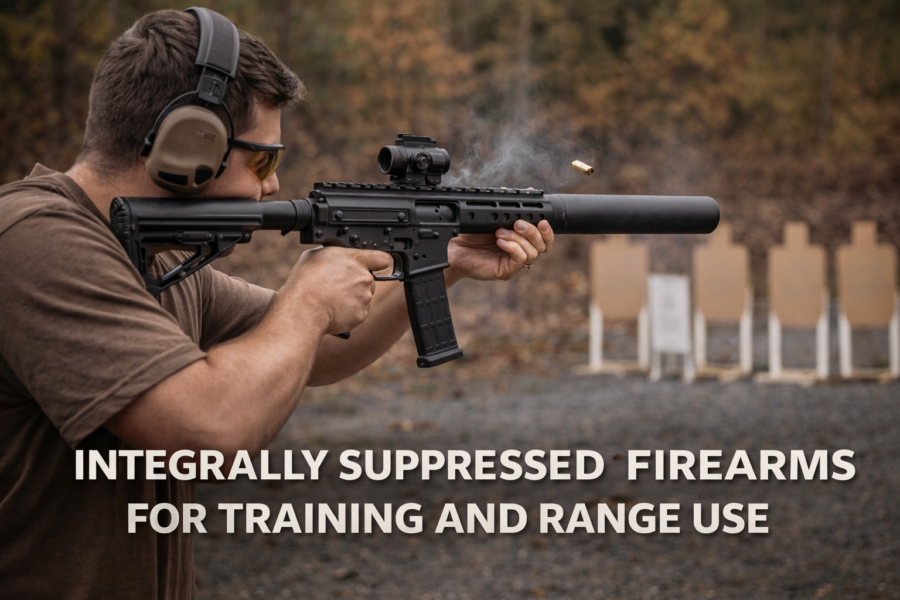
Sound suppression continues to gain attention among hunters, recreational shooters, and professionals who value reduced noise and recoil control. Two primary configurations dominate the discussion: integrally suppressed firearms and traditional detachable suppressor setups.
Both systems are designed to lower the sound signature of a firearm by slowing and cooling expanding gases before they exit the muzzle. The question many shooters ask is straightforward: are integrally suppressed firearms actually quieter than traditional suppressor configurations?
The answer depends on design, caliber, ammunition selection, and intended application. Understanding how each system functions provides clarity.
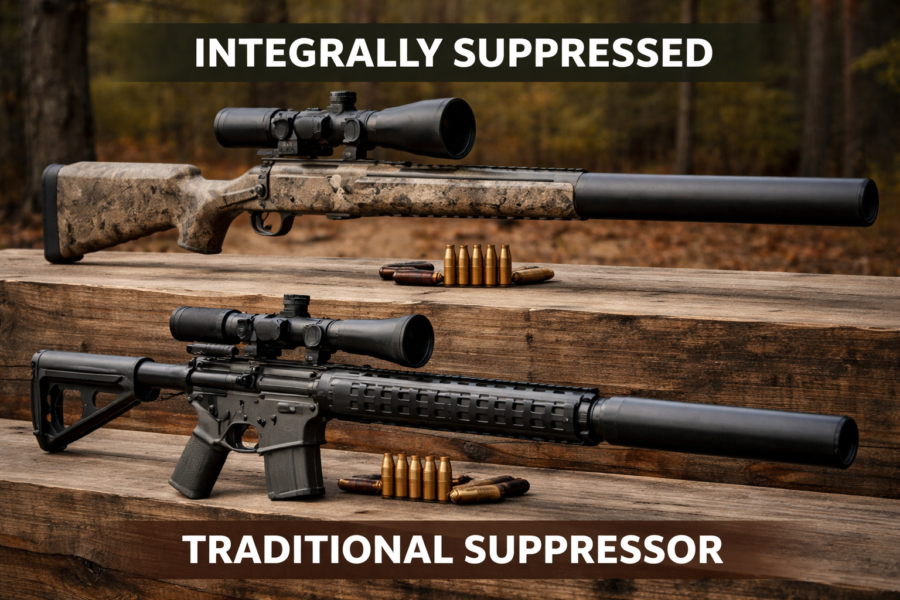
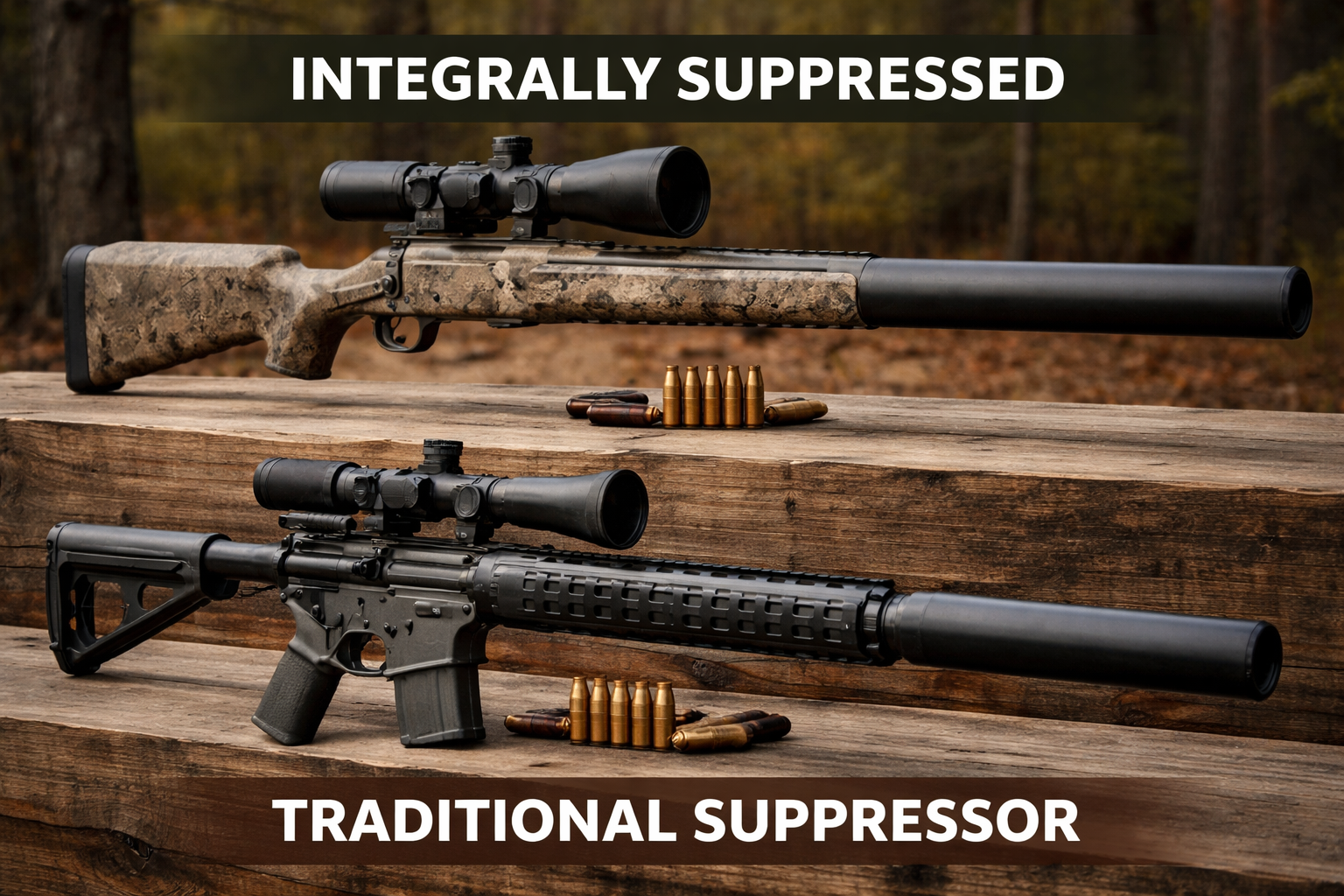
A traditional suppressor attaches to the threaded muzzle of a firearm. Once installed, it contains a series of internal baffles that capture and redirect expanding gases. As gases move through the suppressor body, pressure decreases and sound is reduced before release into the air.
Key characteristics of detachable suppressors include:
Sound reduction levels vary based on suppressor length, internal volume, and ammunition. Many quality suppressors reduce muzzle report by 20 to 35 decibels depending on the system.
An integrally suppressed firearm incorporates the suppressor directly into the barrel assembly. Instead of attaching a separate device at the muzzle, the barrel and suppressor are engineered as one unified system.
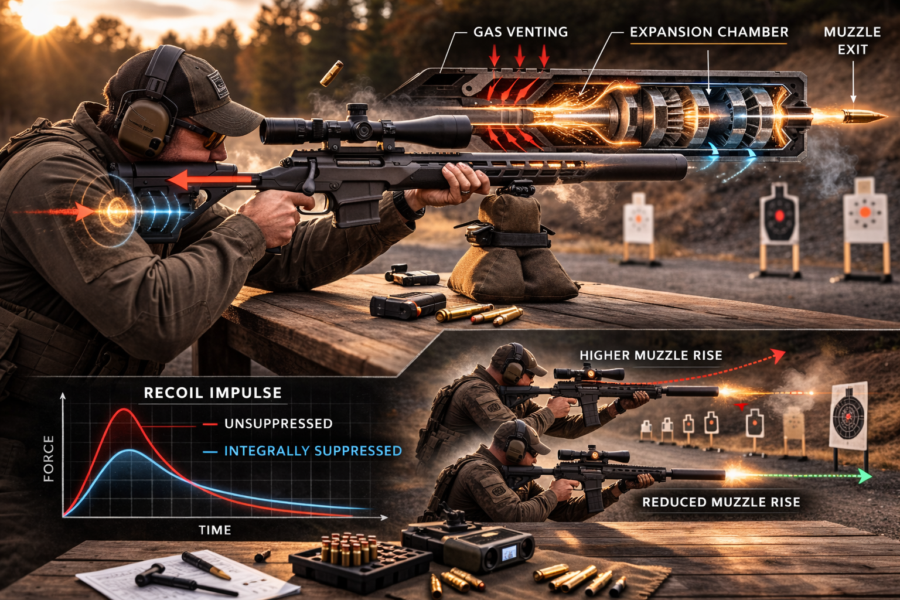
In many designs, small ports in the barrel vent gases into the surrounding suppressor housing before the bullet exits. This allows pressure reduction to begin earlier in the firing cycle compared to a standard muzzle-mounted suppressor.
This design can provide:
Because the suppressor is built into the firearm from the start, engineers can tune barrel length, porting, and expansion chamber size for specific performance goals.
Firearm sound is typically measured in decibels using specialized meters. A difference of 3 decibels represents a noticeable change. A reduction of 10 decibels represents a significant perceived drop in sound intensity.
Unsuppressed centerfire rifles often produce sound levels exceeding 160 decibels. Suppressed systems commonly reduce that level to the 130–140 decibel range depending on configuration and ammunition.
Subsonic ammunition plays a major role. Even the most advanced suppressor cannot eliminate the sonic crack produced when a bullet exceeds the speed of sound. Integrally suppressed firearms designed around subsonic ammunition often demonstrate impressive sound reduction because they address both muzzle blast and projectile velocity.
In many cases, integrally suppressed firearms can achieve slightly lower overall sound levels compared to traditional detachable suppressors of similar size. This advantage comes from earlier gas venting and system optimization.
However, the difference is not always dramatic. A high-quality traditional suppressor mounted on a properly tuned firearm can perform at nearly the same level as an integral system.
The potential sound advantage of an integrally suppressed firearm becomes more apparent when:
In these conditions, integrally suppressed platforms may offer marginally quieter performance.
A common misunderstanding is that suppressor design alone determines sound output. Ammunition selection has equal importance.
Supersonic ammunition produces a ballistic crack that no suppressor can eliminate. Subsonic ammunition avoids this effect, leading to significantly quieter shots.
Many integrally suppressed firearms are engineered to function optimally with subsonic loads. Some even reduce velocity of standard ammunition through barrel porting, ensuring the projectile remains below the speed of sound.
Traditional suppressor setups can also use subsonic ammunition effectively. When paired with the right load, a detachable suppressor can rival integral systems in perceived quietness.
Beyond raw decibel numbers, shooter perception matters. Integrally suppressed firearms often provide smoother gas flow and reduced muzzle blast directed toward the shooter.
This can result in:
Traditional suppressors vary widely in backpressure characteristics. Some models increase gas blowback in semi-automatic platforms, while others are engineered for lower backpressure performance.
An integrally suppressed system designed as a cohesive unit may offer a more refined overall shooting experience, even when decibel differences are small.
A detachable suppressor increases overall firearm length. For rifles, this can affect maneuverability in tight spaces or wooded terrain.
Integrally suppressed firearms frequently maintain a more compact profile because suppressor components are distributed around the barrel rather than extending entirely beyond it.
Although overall sound reduction may be similar between systems, improved balance and handling often influence a shooter’s perception of performance.
Traditional suppressors offer flexibility. One suppressor can serve multiple firearms of the same caliber. This appeals to shooters who want adaptable equipment.
Integrally suppressed firearms are dedicated systems. The suppressor cannot be removed and used on another host firearm. While this limits versatility, it ensures consistent alignment and performance specific to that platform.
Maintenance practices also differ. Some integrally suppressed designs require manufacturer servicing depending on construction and caliber.
Integrally suppressed firearms are well suited for:
Traditional suppressor setups excel in:
Sound reduction performance often overlaps significantly between these two approaches.
Integrally suppressed firearms can be slightly quieter than traditional suppressor setups when engineered around subsonic ammunition and optimized gas control. Their unified construction allows earlier pressure reduction and consistent alignment.
High-quality detachable suppressors, however, deliver impressive sound reduction that closely approaches integral systems in many real-world applications. The measurable difference in decibel levels may be modest depending on configuration.
Choosing between these systems involves more than raw sound data. Intended use, firearm versatility, maintenance preferences, and handling characteristics all contribute to the decision.
For shooters seeking a purpose-built platform designed around quiet performance, an integrally suppressed firearm offers a refined solution. For those who value flexibility across multiple firearms, a traditional suppressor setup remains highly effective.