
Loading...
Loading...
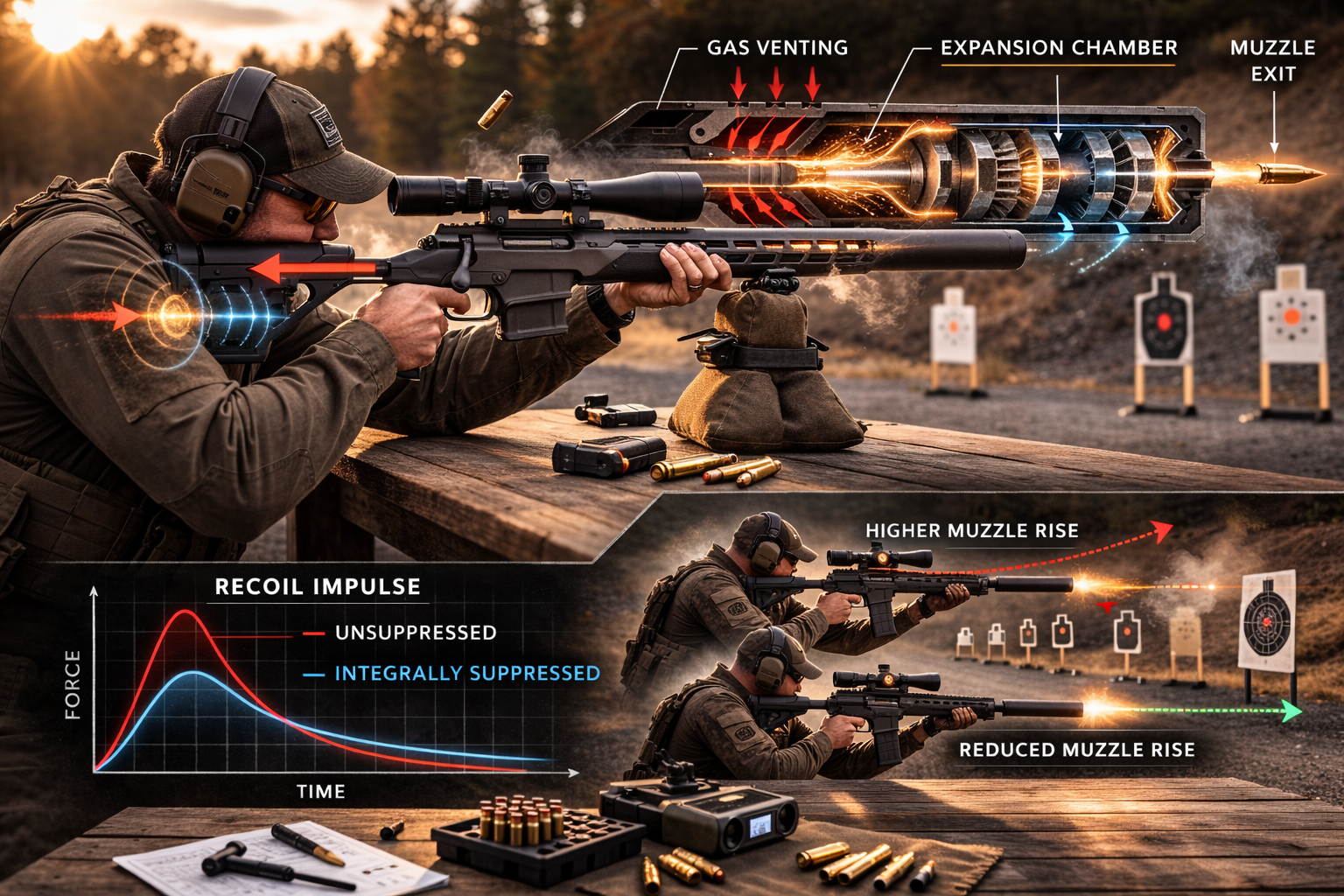
Recoil and muzzle rise influence accuracy, follow-up shot speed, and overall shooting comfort. Managing these forces plays a central role in hunting, defensive applications, and range training. Integrally suppressed firearms offer a design approach that addresses both recoil impulse and barrel movement through engineered gas control.
By incorporating the suppressor into the barrel system, these firearms alter how expanding gases behave after ignition. The result is a smoother shooting cycle and improved control during rapid or precision shooting.
Recoil occurs when expanding gases propel a projectile forward, creating an equal and opposite rearward force against the firearm. This rearward motion transfers through the stock or grip into the shooter.
Several factors influence recoil intensity:
Heavier firearms typically absorb recoil more effectively. Gas-operated systems also redistribute energy differently than bolt-action or fixed-breech designs.
Muzzle rise, sometimes called muzzle climb, results from the rotational force generated during recoil. Because the bore axis sits above the shooter’s grip or shoulder contact point, recoil pushes backward while simultaneously rotating the barrel upward.
This upward movement affects:
Controlling muzzle rise supports tighter shot groups and faster engagement transitions.
Integrally suppressed firearms manage gas earlier in the firing cycle than traditional muzzle devices. Many designs incorporate barrel porting, which allows gases to vent into the surrounding suppressor housing before the projectile exits the barrel.
This early gas diversion reduces pressure at the muzzle. Lower muzzle pressure decreases the abrupt rearward impulse commonly associated with standard unsuppressed firearms.
By distributing gas expansion across a larger internal volume, integrally suppressed systems create a more gradual release of energy. This smoother energy transfer directly influences felt recoil.
Integrally suppressed firearms typically add mass around the barrel. This added forward weight contributes to recoil reduction through basic physics. Greater mass requires more force to accelerate, which helps moderate rearward movement.
Forward weight also counteracts upward barrel rotation. When recoil begins, the additional mass resists rapid muzzle climb, promoting a flatter shooting profile.
Balanced weight distribution allows shooters to maintain sight alignment and observe impacts more effectively.
In traditional setups, gases exit the muzzle abruptly, creating sharp blast and impulse. Integrally suppressed firearms contain these gases within expansion chambers built into the barrel assembly.
The suppressor housing provides space for gases to expand, cool, and slow before release. This staged pressure reduction lessens the sudden shock felt by the shooter.
Benefits of controlled gas expansion include:
This mechanical advantage supports both precision shooting and rapid engagement drills.
In semi-automatic platforms, recoil control also depends on how the action cycles. Integrally suppressed firearms can influence bolt speed and gas system timing, depending on design.
By venting gases earlier and lowering peak pressure at the muzzle, these systems may produce smoother cycling behavior. Reduced bolt velocity often translates into less perceived recoil and diminished sight disruption.
Gas tuning remains important. Proper configuration ensures reliable cycling without excessive backpressure.
Muzzle blast contributes to perceived recoil. The concussion created by high-pressure gas exiting the barrel amplifies the sensation of force.
Integrally suppressed firearms minimize this blast through internal containment. Lower blast intensity reduces the shockwave directed toward the shooter’s face and body.
This reduction improves comfort during extended sessions and helps maintain stable body positioning. When shooters experience less disruption, they retain control more consistently.
Subsonic ammunition complements integrally suppressed platforms effectively. Lower velocity rounds generate less overall pressure, which further reduces recoil intensity.
When paired with a purpose-built integrally suppressed firearm, subsonic loads offer:
While recoil reduction also occurs with supersonic ammunition, subsonic rounds often create the most noticeable improvement in controllability.
Precision shooters rely on consistent sight alignment and minimal movement during firing. Integrally suppressed firearms support this goal by moderating both rearward impulse and upward barrel motion.
Reduced recoil and muzzle rise allow shooters to:
In long-range environments, maintaining sight picture after the shot provides valuable feedback for ballistic adjustment.
In defensive training or competitive settings, rapid target transitions demand stable firearm control. Excessive muzzle climb slows reacquisition and reduces efficiency.
Integrally suppressed firearms provide:
Controlled recoil supports smooth shooting rhythm and consistent performance under time pressure.
Shooters who experience less recoil often focus more effectively on core fundamentals. Grip strength, trigger control, and stance become easier to refine when disruptive force is minimized.
This controlled environment encourages repetition. Repetition builds familiarity and confidence. Over time, consistent recoil characteristics lead to measurable skill improvement.
Youth shooters and recoil-sensitive individuals particularly benefit from platforms that reduce sharp impulse and muzzle climb.
Frequent shooting sessions expose the body to repetitive force. Over time, excessive recoil can contribute to shoulder fatigue and decreased enthusiasm for practice.
Integrally suppressed firearms provide a smoother experience that encourages continued range time. Comfortable shooting fosters regular practice and steady performance gains.
Reduced blast also protects hearing when combined with appropriate ear protection, contributing to overall shooting health.
Integrally suppressed firearms reduce recoil and muzzle rise through engineered gas control, increased forward mass, and controlled pressure release. By venting gases earlier and distributing energy across internal expansion chambers, these platforms create a smoother shooting cycle.
The result is improved stability, faster follow-up shots, and greater shooter comfort. From precision applications to dynamic drills, integrally suppressed firearms provide meaningful advantages in recoil management and barrel control.